
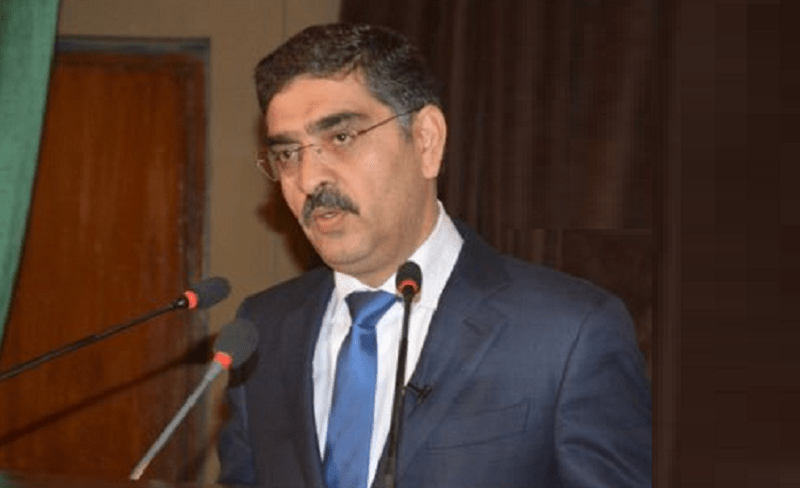
The project to reform Pakistan’s Federal Board of Revenue (FBR) into the National Tax Authority (NTA) was rejected by the country’s caretaker Prime Minister Anwaar-ul-Haq Kakar, the Express Tribune reported on November 30. , citing his own sources.
The Prime Minister reportedly disagreed with the reform plan as it violated Pakistan’s constitutional order and also questioned whether the interim government had the mandate to undertake such structural reforms.
Sources said the government will now form another committee to review the tax service reform plan. It will be headed by the author of the previous project, the acting head of the Ministry of Finance, Shamshad Akhtar. Besides her, the committee will include the Privatization Minister, the head of the National Database and Registration Authority (NADRA), officials from the Prime Minister’s Office and the FBR.
At the same time, Prime Minister Kakar was reported to have approved other administrative measures unrelated to the restructuring of the FBR. In particular, the department is tasked with preparing data for possible expansion of the tax base in Pakistan, as well as new schemes for data sharing between departments in this regard.
Kakar also supported increasing taxes for retail chains, which would be equivalent to three times the rent of commercial space.
Recall that under the plan proposed by Shamshad Akhtar, which was rejected by the Prime Minister, the NTA would be given powers to collect taxes at both the federal and provincial levels. However, under Pakistan’s constitution, provinces are autonomous, so the new agency could potentially limit that autonomy.
According to the working group that prepared the project, Pakistan’s provinces collect taxes equivalent to less than 1% of GDP, while in neighboring India its states collect 6% of GDP in taxes, that is, the emphasis shifts towards federal subjects.
Furthermore, the drafters of the reform plan recommended separating the Customs Service and the FBR, but this proposal also did not find the support of the Prime Minister.
It is noteworthy that under pressure from the IMF and its program of “free” financial assistance in exchange for reforms, Pakistan was ordered to increase the tax base and increase a number of taxes, including sales tax, trade tax of fuel and a series of taxes. of others.
Source: Rossa Primavera

I am Michael Melvin, an experienced news writer with a passion for uncovering stories and bringing them to the public. I have been working in the news industry for over five years now, and my work has been published on multiple websites. As an author at 24 News Reporters, I cover world section of current events stories that are both informative and captivating to read.